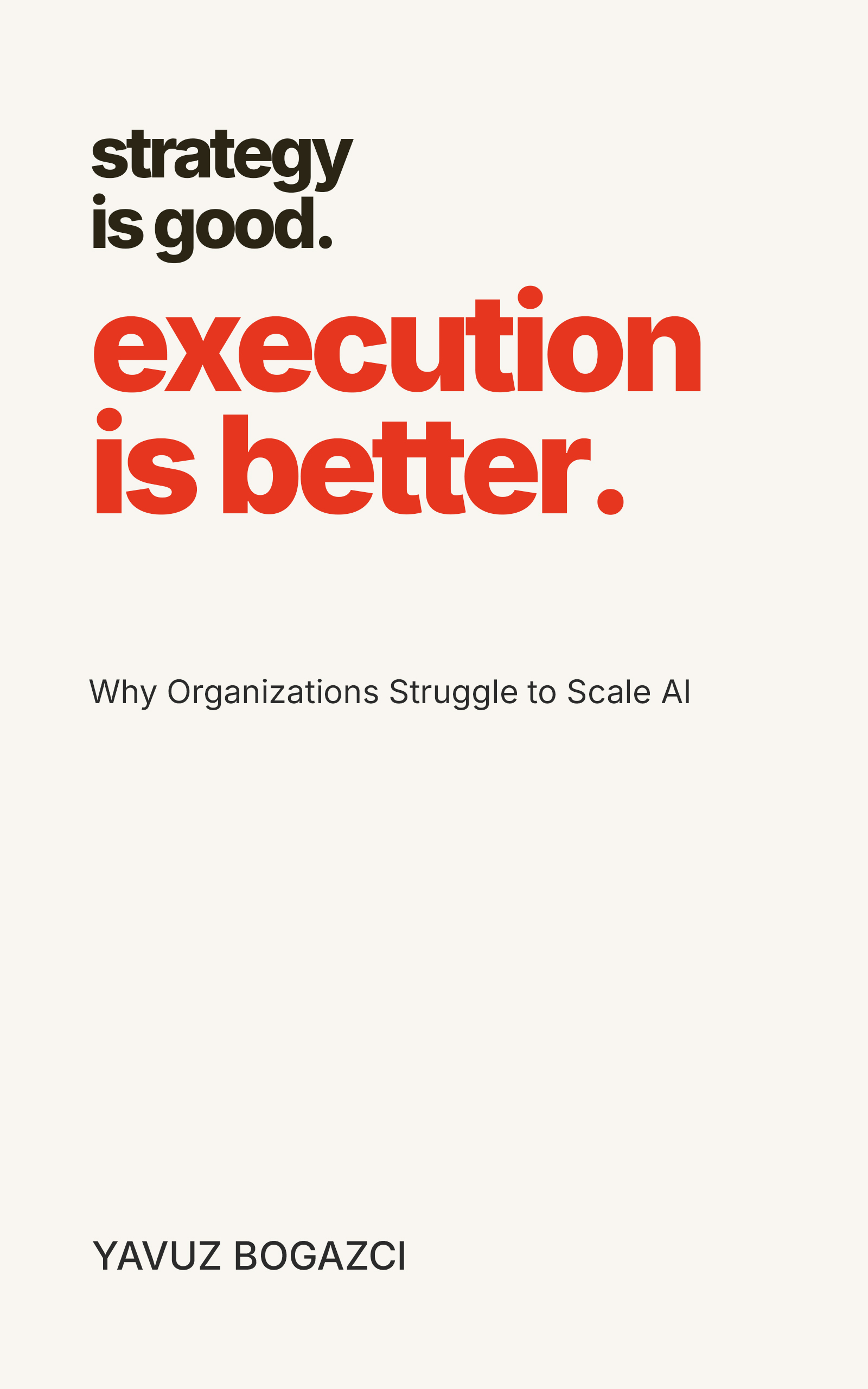
strategy
is good.
execution
is better.
Why organizations struggle to scale AI.
Everyone has a strategy. Few have impact. Most organizations do not fail at AI because they lack a plan — they fail because the plan became a substitute for action.
An indictment with a verdict.
In Strategy is Good. Execution is Better., Yavuz Bogazci confronts the uncomfortable gap between AI ambition and operational reality. Drawing on nearly three decades of hands-on experience in software engineering, data platforms, cloud, and AI transformation — and having led large-scale implementations in regulated, infrastructure-critical industries — he delivers a verdict that many leaders sense but few are willing to say out loud:
The technology works.
The organization does not.
This is not a book about trends, hype, or fashionable AI vocabulary. It is not a technical manual. It is not a consulting playbook.
It is a deliberately built tool for CEOs, CIOs, CDOs, and board members who are done with workshops, presentations, and pilot cycles — and ready to own the first scalable AI outcome.
- · Not another AI hype-book
- · Not a playbook
- · Not another AI manual
Five convictions.
No hedge.
The book is built around five convictions — each forged against twenty-eight years of work inside engineering, data platforms, cloud, and AI. The chapters do not argue. They report.
The strategy deck is no longer the start of the work, it is the substitute. The pilot is no longer the proof of it, it is the alibi. Both become designed to defer the decision the organization must take.
Treating AI as another tool guarantees the cosmetic outcome: a deployment that runs, an org-chart action that does not change, and a KPI that does not move. AI scales only when the operating model bends.
The model is the last 10%. The other 90% is the messy, expensive, invisible work most organizations refuse to fund: contracts, ownership, pipelines, retirement, on-call. That work is the moat.
When governance becomes the place where projects go to wait, the model bends before the policy approves. Real governance is the speed contract between leadership and the team, not the boundary of the committee.
The constraint is never the model, the GPU, or the data. The constraint is the chair that has not been claimed: the person willing to be accountable for the productive result — and the friction to it.
Lines that travel.
Four verdicts from inside the book — each engineered to detach from its chapter and travel as a line in a meeting, a deck, a post.
The rooms where decisions get made — or delayed.
Written for readers who are done with decks, alignment workshops, and pilot cycles — and ready to own the first scalable AI outcome.
For executives steering a stalled, practitioner-written take on AI execution — leadership, strategy, governance, and the operating model behind real adoption.
Yavuz Bogazci

Available on every major store.
Available on every major store — Kindle and Paperback, Apple Books, and Google Play. Same chapters, same text on every platform.
Amazon Paperback
- ISBN
- 979-8-89778-922-1
- Published
- May 19, 2026