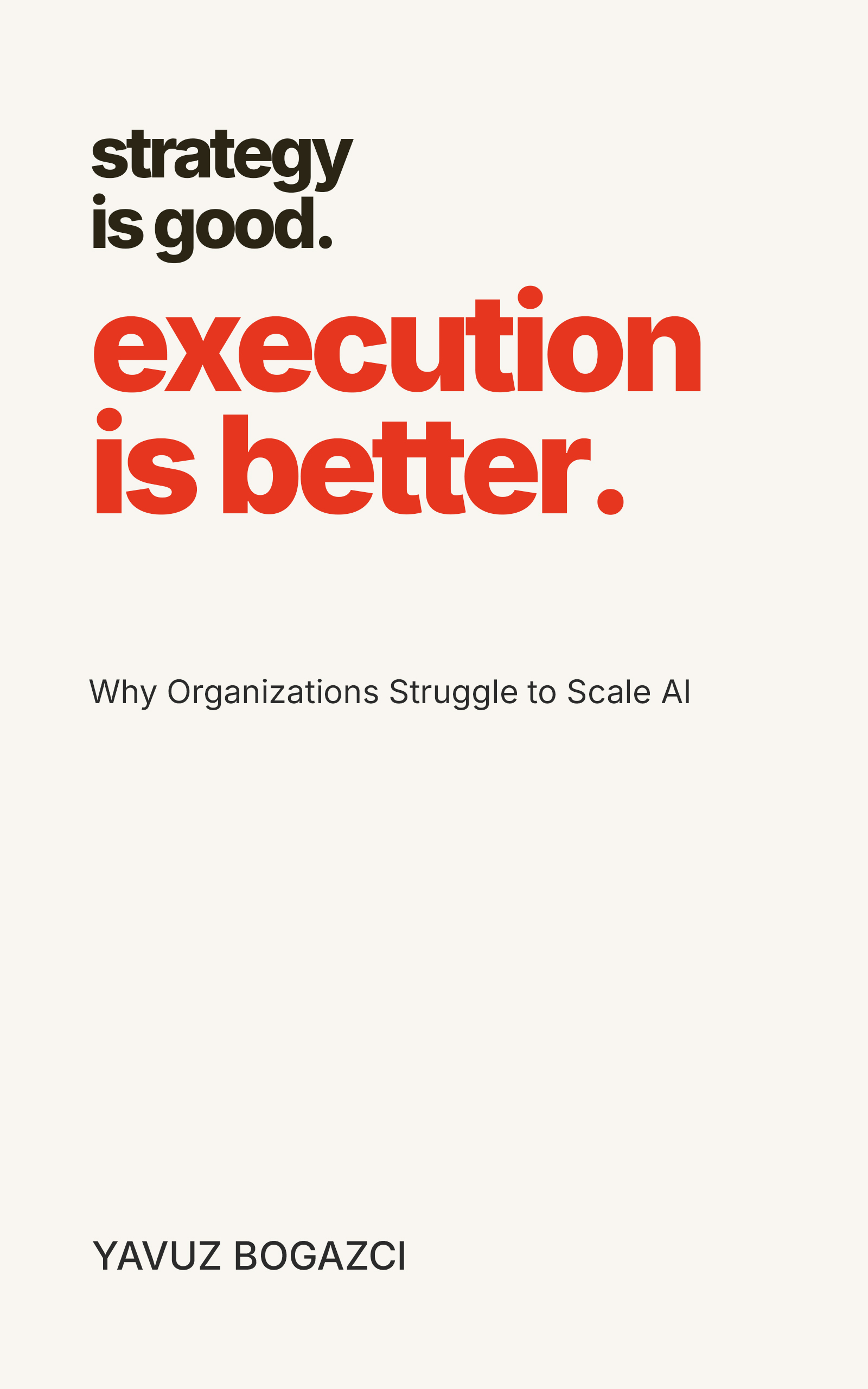
Yavuz Bogazci is a technology executive, Enterprise AI practitioner, author, and keynote speaker with 28 years of experience across software engineering, data, cloud, and artificial intelligence. He is Managing Director at valantic Software & Technology Innovations, Co-Owner of valantic’s Telco Practice, and Head of Tech Partnerships. His work focuses on why AI strategies and successful pilots so often fail to become scalable operational reality, and why AI must be treated not as another tool, but as a system shift that requires organizations to rethink processes, accountability, and operating models. He is the author of Strategy is Good. Execution is Better.
Midsize bio (204 words)
Yavuz Bogazci is a technology executive, Enterprise AI practitioner, author, and keynote speaker with 28 years of experience across software engineering, enterprise architecture, data, cloud, and artificial intelligence.
A self-taught technologist, he began programming at the age of eleven, sold his first commercial software application at fifteen, and built his career from hands-on software development to executive leadership. Over the course of his career, he has worked with some of Europe’s largest enterprises and public-sector organizations, advised CEOs, CIOs, boards, and senior technology leaders, and led complex technology and transformation initiatives across telecommunications, energy, automotive, financial services, consumer goods, manufacturing, and the public sector.
Today, Yavuz is Managing Director at valantic Software & Technology Innovations, Co-Owner of valantic’s Telco Practice, and Head of Tech Partnerships.
At the center of his work is a clear conviction: AI is not another tool to hand to employees. Adding AI to unchanged processes may accelerate individual tasks, but it does not transform an organization. Real impact requires companies to rethink end-to-end processes, decision-making, accountability, governance, and operating models.
He is the author of Strategy is Good. Execution is Better. and writes and speaks regularly about Enterprise AI execution, digital sovereignty, technology leadership, and the future of software engineering.
Long bio (496 words)
Yavuz Bogazci is a technology executive, Enterprise AI practitioner, author, and keynote speaker with 28 years of experience across software engineering, enterprise architecture, data, cloud, and artificial intelligence. He is Managing Director at valantic Software & Technology Innovations, Co-Owner of valantic’s Telco Practice, and Head of Tech Partnerships.
A self-taught technologist, Yavuz began programming at the age of eleven and sold his first commercial software application at fifteen. He started his professional career as a software developer in 1998 and built his path from hands-on engineering to architecture, product development, technology leadership, business development, and executive management.
His perspective is grounded in practical delivery. He has developed enterprise software, built databases and data platforms, shaped technology roadmaps and go-to-market strategies, and led multidisciplinary engineering and transformation teams. His technical foundation includes extensive work with technologies such as Java, Microsoft .NET and C#, Oracle, and Microsoft SQL Server. Before joining valantic, he held senior technology, data, AI, and go-to-market leadership roles at organizations including CGI and Capgemini.
Throughout his career, Yavuz has worked with some of Europe’s largest enterprises and public-sector organizations across telecommunications, energy and utilities, automotive, financial services, consumer goods, manufacturing, and transportation. He has advised CEOs, CIOs, boards, and senior technology leaders and has taken responsibility for complex, business-critical transformation programs. As Factory Lead, he was responsible for a large-scale modernization initiative covering more than 2,000 databases and over 300 enterprise applications.
This combination of engineering depth and executive accountability shapes his view of artificial intelligence. At the center of his work is a simple conviction: AI is not a tool that organizations can hand to employees like a hammer. Adding AI to unchanged processes may make individual activities faster, but it does not necessarily make the organization more productive, more responsive, or more competitive. Real transformation requires companies to rethink end-to-end processes, responsibilities, decision rights, governance, and operating models around the new capabilities AI introduces.
Yavuz argues that most organizations do not struggle with AI because the technology is insufficient. They struggle because ownership remains unclear, legacy processes remain untouched, governance delays decisions, and successful pilots are never converted into reliable production systems. For him, production rather than the pilot is the only honest measure of progress.
He also examines how AI shifts the bottleneck from generation to review, why professional judgment and accountability become more important as output becomes cheaper, and why digital sovereignty must be understood as conscious control over technological dependencies rather than as a question of infrastructure alone.
These convictions form the foundation of his book, Strategy is Good. Execution is Better., which explores why organizations repeatedly fail to turn AI ambition into scalable operational impact. Through his writing on iamyb.com, his LinkedIn newsletter, boardroom discussions, and keynotes, Yavuz addresses Enterprise AI execution, digital sovereignty, software engineering, leadership, and the organizational realities behind technological change.
His work is defined by a practitioner’s standard: strategy matters, but it only creates value when an organization is willing and able to execute.