The Treadmill: Execution Wearing Another Costume
The AI industry crowns a new “this is THE skill now” roughly once a month, and almost every time it is the same discovery wearing a new word.
A new term lands. A manifesto follows. A post crosses several million views over a weekend, and the timeline reorganizes itself around it. By the time you have read the thread, blocked an afternoon to learn it, and updated your mental model, the next word is already loading. You are not falling behind. You are on a treadmill — and the belt is set to “monthly.”
I run loops daily. I would hire forward-deployed engineers tomorrow. These are real tools and real roles, and I am not here to mock them. I am here to name the constant they keep rediscovering, because the people who see the constant were ready for every one of these terms before they had names.
The lineage runs on rails
Line up the last four “essential skills” and the pattern is hard to miss.
2022: prompt engineering. Phrase the request correctly and the model behaves.
2024: context engineering. Phrasing was not enough — assemble the right context window, the right documents, the right state.
2025: harness engineering. Context was not enough — build the scaffolding around the model that feeds it tools and catches its output.
2026: loop engineering. The harness was not enough — design the Plan → Act → Verify cycle that runs the model without you in the chair.
On 7 June 2026, Peter Steinberger — creator of the most-starred new repo on GitHub — posted roughly twelve words: you should not be prompting coding agents anymore, you should be designing loops that prompt your agents. It reached about 6.5 million views over a weekend. Days earlier, Boris Cherny, who heads Claude Code at Anthropic, had said on stage that he does not prompt Claude anymore — he has loops running, and they are the ones prompting Claude. His canonical starter loop is named “babysit my PRs.” The verb is the point: supervision.
Andrej Karpathy pointed an autonomous research agent at code he had already optimized. It ran about 700 experiments in two days and found 20 genuine improvements — an 11% training speedup. The tool was 630 lines of Python. “All LLM frontier labs will do this,” he wrote. “It’s the final boss battle.” Humans, he added, optionally contribute on the edges.
Each of these arrived dressed as a break with the last one. Each was sold as the new literacy. And each was the same realization, one layer deeper: the model is not where the work is.
The job title is doing the same thing
The lineage is not confined to skills. It shows up in hiring.
The month before loops took over the discourse, the crowned role was the Forward-Deployed Engineer. Postings rose roughly 800% across Jan–Sep 2025; on Indeed they were up 729% year over year — 643 in April 2025, 5,330 in April 2026. Salesforce committed publicly to hiring 1,000 of them. In April 2026, EY stood up a dedicated FDE practice in the UK and Ireland, the first major consultancy to formally adopt the model. OpenAI, Anthropic, Palantir, Databricks — all building the function.
An FDE is not a sales engineer. They embed in your operations, write the production code, fix what breaks, and stay on the account until a business metric actually moves.
Now read an FDE job description and a loop manifesto back to back. They confess the same thing.
The bottleneck stopped being the model and became everything around it — integration, data, verification, ownership.
The loop people say it in their own way. A standard production setup uses one agent to write code and a second to verify it, because the model that wrote the code is far too lenient grading its own work. That sentence is a confession. It admits the generating half is cheap and the verifying half is the job. No amount of prompting fixes that. No new word changes it either.
The line nobody wants to say out loud
Here is the part the monthly cycle keeps stepping around.
The model was never the hard part. The hard part was always the system around it.
I wrote a version of this in my book, and the discourse has spent the last two years arriving at it from every direction without saying it plainly. The model is the ten percent you can see. The platform around it — integration, data pipelines, process redesign, security, verification, ownership — is the ninety percent that makes it work.
Ten percent AI. Ninety percent everything else.
That ratio does not move when the vocabulary moves. Prompt engineering was a way of working on the ten percent. So was context engineering, and harness engineering, and loop engineering, and the FDE motion. Every one of them is a fresh attempt to get a grip on the ninety percent — and every time, the industry renames the attempt so it feels like news rather than a return.
The bill makes the point better than any manifesto. Uber exhausted its full 2026 AI-coding-tools budget in four months and imposed a hard cap of $1,500 per employee per month, per tool. Once the model writes code for nearly free, the cost moves to running the loop. The expense did not vanish with a clever word. It relocated to the ninety percent, the way it always does.
And watch where the loops actually run. The one everyone photographs — the agent writing and testing its own code — runs in minutes and costs almost nothing. The loops that decide whether any of it was worth building run in hours and days: someone steering the work toward what the user actually needs, someone putting it in front of real people and waiting for the answer. The fast loop is the cheap half. The slow loops are the job. You can compress the minutes all you like; the hours and the days are where value is won or lost, and no rename shortens them.
The trap, stated cleanly
Here is what the treadmill costs you if you ride it.
Chase the newest word every month and you are permanently a beginner. You are always one manifesto behind, always re-learning the surface, always treating the rename as a curriculum. You mistake the costume for the body underneath.
Understand the constant instead, and the math inverts. You were ready for prompt engineering before it was named, because you already knew the request had to be specified well. You were ready for context and harness and loop engineering, because you already knew the model needed a system around it to do anything that survived contact with production. You were ready for the FDE, because you already knew someone has to own the last mile.
Old: learn the term, then go looking for what it means.
New: understand the constant, then watch the terms confirm it.
The people who are calm right now are not the ones who learned loop engineering fastest. They are the ones who never believed the model was the work in the first place.
Name the constant
So name it plainly, because the renaming depends on it staying unnamed.
The constant is execution.
The shiny term is the strategy of the month. It is the slide, the manifesto, the six-million-view post — the thing that feels like progress because it is new. What actually ships value is the boring thing underneath every one of those terms, and it does not change when the word does. Integration still has to hold. Data still has to be clean. The verification step still has to be able to say “no.” Someone still has to own what ships.
And the reason that someone is still a person is not taste. It is context. You know the user, the regulation, the edge case the process breaks on, the lesson the last incident burned in — and the model does not. As long as you know something the model does not, you are in the loop to put it there. That is not sentiment about human value. It is the mechanic that keeps the ninety percent from being automated away with the ten.
I have argued this one way for a long time:
The goal of execution is not to showcase AI. It is to make it boring.
The loop is not exciting because it is a loop. It is useful when it makes a real process boring — predictable, owned, no longer “the AI thing,” just the demand forecasting or the claims management that happens to run on a model now. The FDE is not valuable because the title is new. They are valuable because they drag a capability through the unglamorous ninety percent until it works.
Strategy is good. The new word is good — it sharpens how we talk about the work. But execution is better, and execution is the part that survives every rename.
The verdict
So here is where I land, and where I would put your attention.
Watch the constant, not the costume. The term will change again before the summer is out — it always does — and the people calm about it will be the ones who already understood what it points at.
Bet on the ninety percent, not the ten. That is where the cost moved, where the ownership sits, and where the value either ships or quietly dies in a pilot.
Judge the next manifesto by one test: does it teach you to execute, or only to re-narrate? If it is the latter, you already know it, because you have read this exact discovery under three other names.
That question is the whole book.
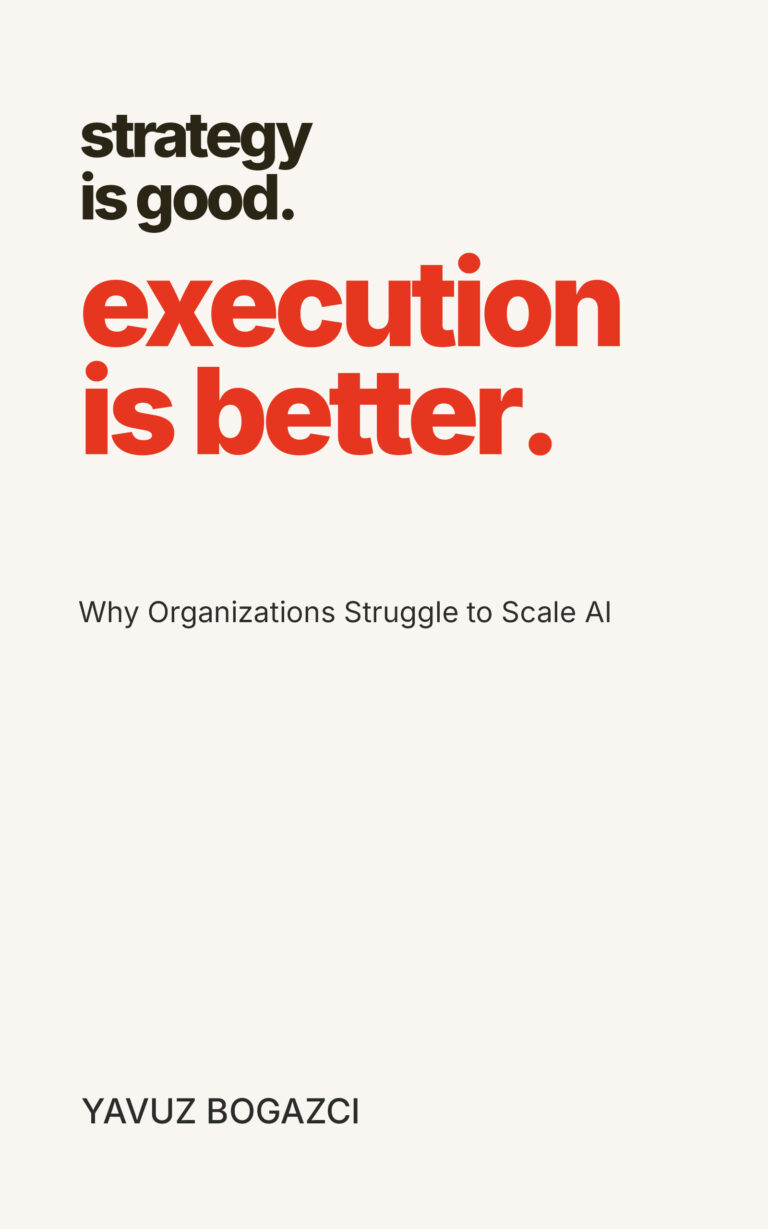
Strategy is Good. Execution is Better.